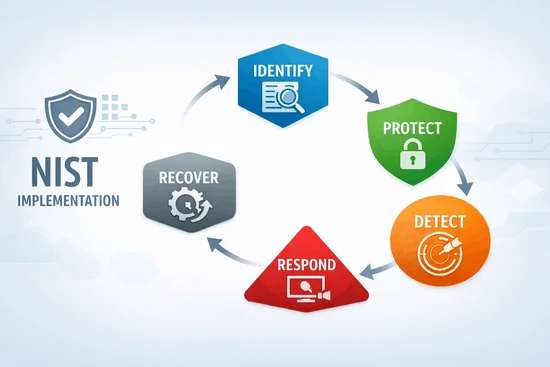

NIST PRISMA (Program Review for Information Security Management Assistance) is a maturity-based cybersecurity assessment method used to evaluate the strength of an organization's information security program. The NIST PRISMA methodology helps organizations measure security maturity, identify control gaps, prioritize risk, and improve overall cybersecurity posture.
Modern organizations face increasing cybersecurity risks, compliance requirements, and audit challenges. Using a structured framework like NIST PRISMA allows businesses to assess their security controls, improve risk management, and align cybersecurity programs with business objectives. Understanding the PRISMA maturity model is important for organizations that want to strengthen governance, risk, and compliance practices.
What is NIST PRISMA?
NIST PRISMA is a maturity-based review methodology developed by NIST to assess the effectiveness of an information security program.
It helps organizations:
- Measure cybersecurity maturity
- Identify control weaknesses
- Prioritize risk
- Improve security governance
- Support audit and compliance activities
PRISMA is commonly used in organizations that follow NIST cybersecurity standards and need a structured approach to security program evaluation.
Read also: DPDP Compliance Software in India (2026 Buyer's Guide)
Why PRISMA is Used in Cybersecurity Programs?
Organizations implement PRISMA to manage complex security requirements and ensure that security controls are applied correctly.
PRISMA helps management:
- Understand current security posture
- Assign risk-based priorities
- Improve control implementation
- Plan corrective actions
- Support compliance programs
PRISMA uses risk rating, control maturity level, and priority codes to decide what should be fixed first.
Read also: DPDP Consent Management Requirements (2026 Guide)
How PRISMA Helps in Risk-Based Security Planning
PRISMA allows organizations to generate risk-based priorities using:
- Control maturity level
- NIST 800-53 priority codes
- Risk rating based on impact and likelihood
This approach helps organizations focus on the most important security risks instead of implementing controls randomly.
Risk-based implementation makes cybersecurity programs more effective and easier to manage.
Read also: DPDP Data Inventory & Mapping Guide (2026 Compliance Framework)
What is the PRISMA Maturity Model?
The PRISMA model is based on the Capability Maturity Model (CMM) used to measure the development level of a security program.
The model defines five maturity levels that show how strong the cybersecurity program is.
Maturity Level 1 - Policies
At this level, the organization has documented security policies.
Focus:
- Written rules
- Security guidelines
- Basic documentation
Maturity Level 2 - Procedures
At this level, procedures exist to support policies.
Focus:
- Defined processes
- Step-by-step actions
- Assigned responsibilities
Maturity Level 3 - Implementation
At this stage, policies and procedures are actually implemented.
Focus:
- Controls in place
- Security tools used
- Processes followed
Maturity Level 4 - Testing
Security controls are tested to verify effectiveness.
Focus:
- Security testing
- Audits
- Control validation
Testing ensures controls work correctly.
Maturity Level 5 - Integration
All security practices are fully integrated into the organization.
Focus:
- Continuous monitoring
- Risk management
- Governance alignment
- Security culture
This is the highest maturity level.
Read also: DPDP DPIA Requirements (2026 Guide for Risk Assessment)
What Does a PRISMA Review Assess?
A PRISMA review evaluates both technical and strategic parts of an information security program.
The review checks:
- Security policies
- Risk management
- Security controls
- Incident response
- Compliance readiness
- Security awareness
The goal is to determine how mature the security program is.
Read also: DPDP Compliance Software in India (2026 Buyer's Guide)
What are the Nine PRISMA Topic Areas?
PRISMA reviews focus on nine important areas of cybersecurity.
These include:
- Information Security Management and Culture
- Information Security Planning
- Security Awareness, Training, and Education
- Budget and Resources
- Life Cycle Management
- Certification and Accreditation
- Critical Infrastructure Protection
- Incident and Emergency Response
- Security Controls
These topic areas cover the full cybersecurity program lifecycle.
Read also: Vendor Risk Management Under DPDP (2026 Compliance Guide)
How PRISMA Review Results Are Classified?
After the review, results are classified as:
- Compliant
- Partially compliant
- Not compliant
This classification helps management understand:
- Current security level
- Required improvements
- Risk exposure
- Priority actions
PRISMA results help organizations plan better cybersecurity strategies.
Read also: DPDP Penalties in India: Fines Under DPDP Act 2023
Why PRISMA is Important for Modern Cybersecurity?
PRISMA helps organizations:
- Build structured security programs
- Reduce cybersecurity risk
- Improve compliance readiness
- Support audits
- Strengthen governance
- Prioritize controls correctly
Without maturity assessment, security programs become expensive and ineffective.
PRISMA helps implement security the right way.
Read also: DPDP DPIA Requirements (2026 Guide for Risk Assessment)
Key Takeaways
- PRISMA is a maturity-based cybersecurity review method
- It uses five maturity levels
- It evaluates security program strength
- It helps prioritize controls
- It supports risk-based implementation
- It improves audit readiness
Organizations using PRISMA can build stronger cybersecurity programs.
Conclusion
NIST PRISMA provides a structured and maturity-based approach to evaluating and improving an organization's information security program. By using the five maturity levels and nine topic areas, organizations can identify gaps, prioritize risks, and strengthen cybersecurity controls in a systematic way.
A risk-based and maturity-driven approach helps organizations reduce security weaknesses, improve compliance readiness, and build a sustainable cybersecurity program that aligns with business goals.
Explore GRC³'s NIST Cybersecurity Framework to manage data protection controls, privacy obligations, consent, risk tracking, and compliance readiness with a structured approach.
If you would like guidance on strengthening your DPDP compliance framework or understanding how governance, risk, and compliance tools can support your organization, feel free to contact us for assistance.
You can also visit our website to explore how modern GRC platforms help organizations manage data protection, risk management, and regulatory compliance in a more structured and scalable way.
FAQs
NIST PRISMA is a maturity-based method used to evaluate the strength of an information security program.
Related Posts