
Data Subject Requests: The Real Measure of Your Privacy Program
Data Subject Requests (DSRs) are formal requests made by individuals to access, correct, or delete their Personal Data. Under the DPDP Act, DSRs act as real-time audits of an organization’s privacy program, testing its ability to locate data, respond accurately, and meet compliance deadlines.
What Are Data Subject Requests (DSRs)?
Data Subject Requests (DSRs) are requests made by individuals (Data Principals) to exercise their rights over personal data, such as access, correction, or deletion.
Under DPDP, individuals can:
- Access their personal data
- Correct inaccurate data
- Request deletion
- Withdraw consent
Organizations must respond accurately and within defined timelines.
Why Are DSRs Important Under DPDP?
DSRs are important because they directly test whether an organization can manage personal data effectively and comply with privacy regulations.
DSRs reveal your ability to:
- Discover personal data
- Track data across systems
- Collaborate across teams
- Respond transparently
Even one failure can lead to:
- Penalties
- Complaints
- Loss of trust
Why Are DSRs Considered a Real-Time Audit?
Every DSR acts as a real-time audit because it requires organizations to prove their data governance capabilities instantly.
A DSR tests:
- Data visibility
- Accuracy of records
- Response timelines
- Audit readiness
If you cannot locate data quickly, your privacy program has gaps.
What Challenges Do Organizations Face in Managing DSRs?
Many organizations struggle to manage DSRs due to manual processes, fragmented systems, and lack of data visibility.
Common challenges:
- Data spread across multiple systems
- Manual data collection
- Lack of coordination between teams
- Time-consuming processes
- High risk of errors
Manual handling leads to: Delays, inefficiency, and compliance risks
How Does Automation Improve DSR Management?
Automation simplifies DSR handling by centralizing data, reducing manual work, and ensuring timely and accurate responses.
Benefits of automation:
- Faster response times
- Reduced human errors
- Centralized tracking
- Audit-ready logs
This improves:Efficiency, compliance, and trust
Why Is Data discovery Critical for DSRs?
Data discovery helps organizations locate all personal data across systems, which is essential for responding to DSRs accurately.
Without data discovery:
- Data remains hidden (dark data)
- Responses are incomplete
- Compliance fails
Data discovery enables:
- Full data visibility
- Accurate responses
- Audit readiness
What Is the Role of ROPA in DSR Management?
Records of Processing Activities (ROPA) provide context about how personal data is processed, helping organizations respond to DSRs accurately.
ROPA helps:
- Identify data purpose
- Track ownership
- Maintain accountability
- Provide audit evidence
ROPA + Data Discovery = effective DSR management
How Do DSRs Help Build Trust?
Efficient DSR handling demonstrates transparency and accountability, helping organizations build trust with customers, regulators, and stakeholders.
Benefits include:
- Improved customer confidence
- Better regulatory compliance
- Strong governance
DSRs can become a competitive advantage.
How Can Organizations Improve DSR Handling?
Organizations should implement structured processes, automation tools, and strong data governance to manage DSRs effectively.
Best practices:
- Use centralized DSR systems
- Implement data discovery tools
- Maintain ROPA
- Automate workflows
- Track response timelines
This ensures: Compliance, efficiency, and scalability
Key Takeaways
- DSRs test your privacy program in real time
- Data discovery is essential for accurate responses
- Manual processes increase risk and delays
- Automation improves efficiency and compliance
- ROPA provides context and accountability
- Effective DSR handling builds trust
Related Resources
Related Posts
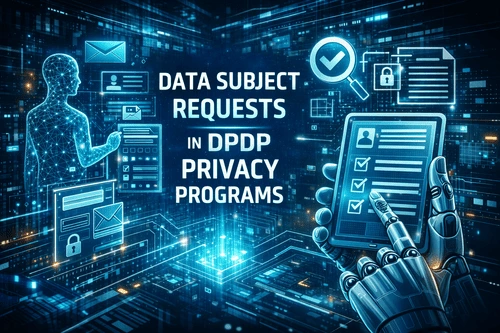
Why Data Subject Requests Are the True Test of Your Privacy Program Under DPDP (2024-2025 Guide)
Data Subject Requests reveal the real strength of your DPDP privacy program. Learn how to manage DSR challenges, reduce risks, and ensure compliant responses.
Read More
Data Subject Requests: The Ultimate Test of Your Privacy Readiness
DSRs are the most visible test of privacy readiness. Learn how to improve data visibility, response workflows, and compliance performance under legal timelines.
Read More
DPDP Compliance and Work from Home: Security Risks, Challenges, and Best Practices (2024-2025 Guide)
Learn how to manage DPDP compliance in work-from-home environments. Discover security risks, challenges, and best practices to protect personal data and reduce compliance risks.
Read More
GRC Insights That Matter
Exclusive updates on governance, risk, compliance, privacy, and audits — straight from industry experts.